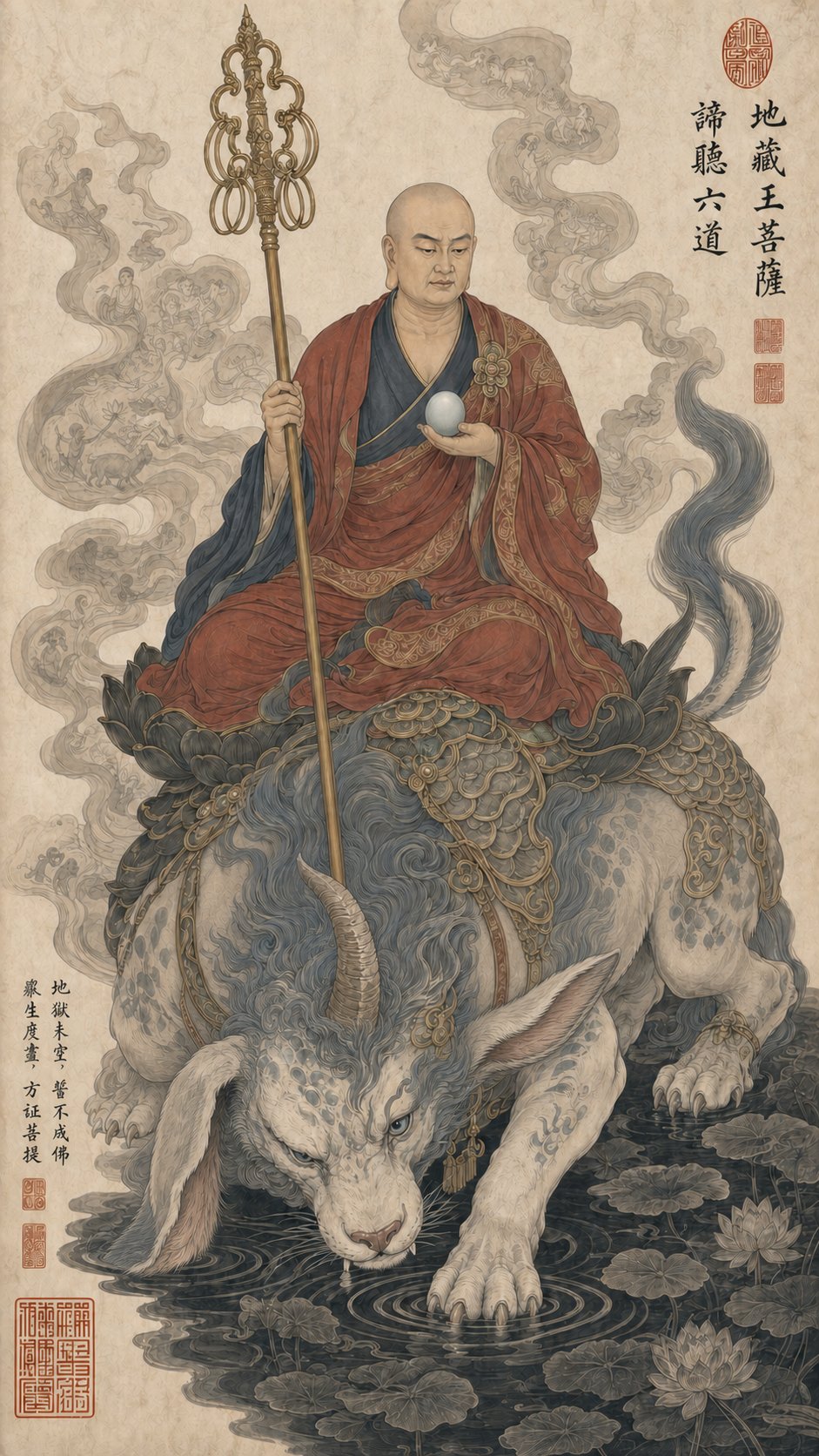
Divine Identity: [e.g., Nüwa / Xihe / Taiji Yuku Tianzun / Ksitigarbha Bodhisattva]
Core Divine Beast / Variant Form: [Tengshe / Three-legged Golden Crow / Nine-headed Lion / Diting / Dharma Wheel / Divine Bird, etc.]
Ritual Implement / Emblematic Object: [Five-colored Stone / Sun Wheel / Willow Purifier Vase / Tin Staff, etc.]
Primary Color Scheme: [Vermilion Gold Black / Mineral Blue Gray White / Ink Blue Antique Gold / Ochre Red Muted Green, etc.]
Overall Aura: [Sacred / Eerie / Majestic / Solemn / Fiery / Mystically Profound]
Composition Style: [Encircling / Radiating / Frontal Dharma Form / Diving Descent / Beasts in Swarming Clusters / Vertical Suppression]
Aspect Ratio: [9:16]
Generate an Oriental deity gongbi-style saintly portrait illustration, seamlessly blending the visual languages of traditional Chinese deity paintings, gongbi heavy-color techniques, white-line engraving, folk woodblock prints, and ancient scripture saintly icon scrolls.
The composition centers on the [Divine Identity] as the core subject, establishing a complete relational structure around the [Core Divine Beast / Variant Form]. Elements such as divine beasts, ritual implements, wings, serpentine bodies, sun wheels, cloud vapors, or swarming beasts must not serve merely as decoration; they should actively participate in the composition, forming evident encircling, diagonal, radiating, vertical suppressive, or front-to-back interweaving relationships, endowing each image with an independent visual "momentum."
The deity's form must retain a dignified, sacred, and imposing presence—avoid rendering it as a modern idol face or generic ancient costume figure. Attire should employ highly detailed traditional divine robes, armor, crowns, and ritual garments, incorporating intricate motifs like cloud patterns, thunder weaves, beast masks, scale textures, scrolling foliage, metallic filigree, and other precise details. Character outlines must be sharply defined, with rich yet non-chaotic detailing.
The [Core Divine Beast / Variant Form] should embody distinct divine-monstrous attributes and visual identifiability, eschewing resemblance to ordinary animals. Fur, feathers, scales, serpentine bodies, beast manes, and the like must be shaped through meticulous, continuous, directional gongbi linework—appearing volumetric from afar, with layered line descriptions visible up close. Avoid photographic fur rendering, CG plastic sheen, or blurred strokes.
The [Ritual Implement / Emblematic Object] must function as a crucial visual symbol of the figure's identity while contributing to the picture's structure. For instance, a long staff may form a diagonal axis, a sun wheel a circular focal core, wings a radiating framework, a serpentine body an S-shaped encircling flow, or swarming beasts a tiered clustering formation.
Coloration should draw from traditional mineral-based heavy pigments, centered on the [Primary Color Scheme] and complemented by tones like ink black, mineral blue, mineral green, antique gold, copper gold, vermilion, ochre red, and ash white. Colors ought to be vivid yet classically refined, with clear layering and weight—steering clear of pale washes or modern neon effects.
The background should evoke the texture of aged rice paper or worn parchment, featuring extensive negative space with only sparse additions of cloud vapors, mists, calligraphic inscriptions, vermilion seals, and essential attribute apparitions. Prioritize high information density in the foreground subject against low density in the background, avoiding elaborate palaces, fully rendered landscapes, or screen-filling effects that overshadow the core.
The overall work must simultaneously evoke: the solemnity of Oriental deities, the eeriness of beastly variant forms, the precision of gongbi linework, the substantiality of mineral heavy colors, and a potent yet lucid compositional dynamism.
Avoid: modern guochao neon aesthetics, 3D game concept art vibes, plastic CG finishes, fractured lines, faded colors, overcrowded backgrounds, rigid figures, mundane beasts, meaningless decorative piling, and excessive text glitches.