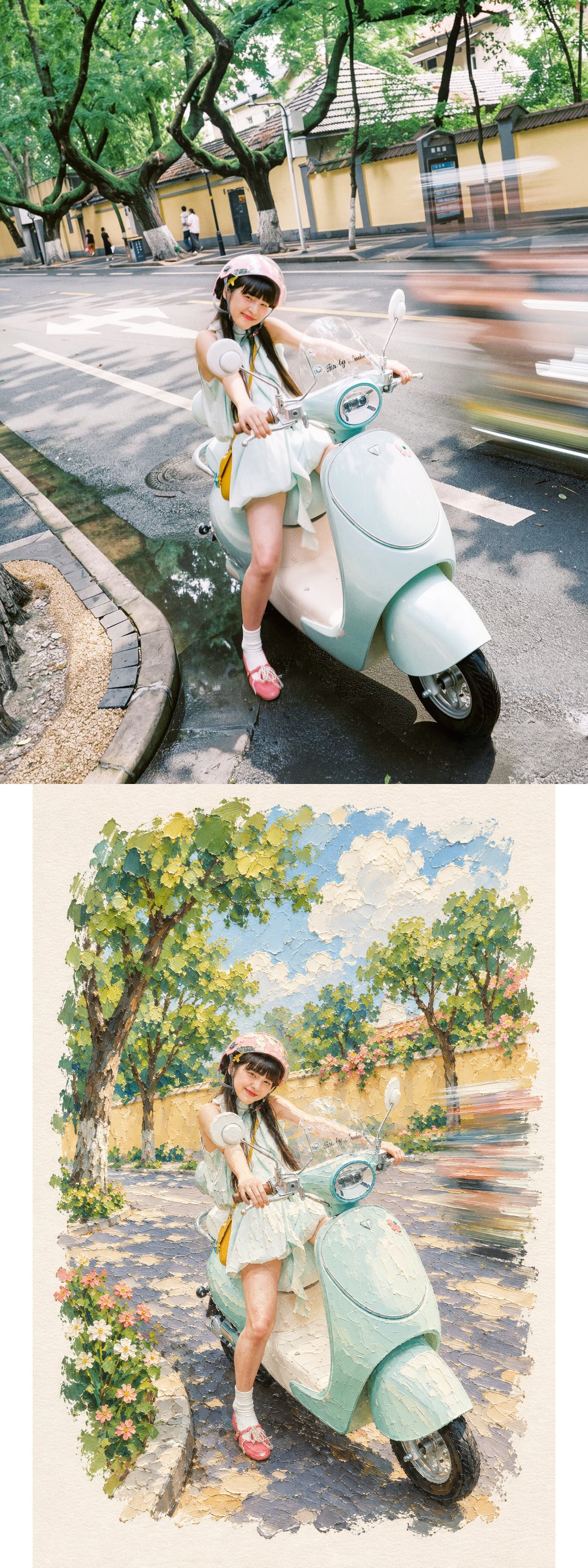
Transform the uploaded photograph into a refined “miniature summer diary” impasto oil-painting illustration presented as an elegant editorial art print.
IMPORTANT — USE THE UPLOADED PHOTO AS THE PRIMARY SOURCE
This is an image-to-image transformation, not a completely new scene.
First identify the main narrative subject or subjects in the uploaded photograph and preserve them faithfully.
Strictly preserve all visually important foreground information:
- the identity and recognizable characteristics of every main person
- the exact number of people
- the exact number and type of important animals
- facial expression and emotional character
- gaze direction
- head orientation
- body pose
- gesture
- limb relationships
- unusual or distinctive poses
- interaction between people
- interaction between people and animals
- important clothing silhouettes
- important clothing colors
- hairstyle
- distinctive accessories
- important vehicles, furniture, sports equipment, playground structures or other story-defining objects
- the relationship and spatial arrangement between the primary subjects
Do not replace the people with generic characters.
Do not beautify them into different people.
Do not substantially change age, face shape, hairstyle, clothing, pose or expression.
Do not correct unusual poses merely because they appear unconventional.
If a person is upside down, jumping, leaning, running or making an unusual gesture in the source photograph, preserve that exact action.
Do not invent additional people or animals.
NARRATIVE RECONSTRUCTION
Do NOT simply apply an oil-paint filter to the entire photograph.
Separate the image conceptually into:
1. HIGH-FIDELITY NARRATIVE FOREGROUND
2. POETICALLY RECONSTRUCTED ENVIRONMENT
Keep the primary subjects and the most recognizable story-defining objects faithful to the photograph.
Simplify, remove or reinterpret visually distracting background elements.
Instead of reproducing every building, road, wall, sign, vehicle or piece of clutter literally, reconstruct the surroundings as a small, idyllic, self-contained painted world inspired by the mood, colors and meaning of the source photograph.
Retain only environmental details that are important to understanding the original scene.
Where appropriate, gently reinterpret ordinary surroundings into a charming summer landscape using restrained elements such as:
- small paths
- soft grass
- tiny wildflowers
- small shrubs
- distant low hills
- calm turquoise or pale blue water
- simplified landscape forms
- airy blue sky
- large soft clouds
- a few tiny birds
- occasional small decorative signposts
These additions must remain secondary and support the original story.
Do not turn the scene into fantasy art.
Do not add castles, magical objects, surreal creatures or dramatic fantasy scenery.
MINIATURE WORLD COMPOSITION
Recompose the scene as a compact miniature-memory vignette or painted diorama.
The subject should feel like a real moment from life preserved inside a small handcrafted world.
Compress the environment gently around the main subject rather than showing an enormous realistic landscape.
Create layered but slightly flattened illustrated depth:
foreground details,
main subject,
midground landscape,
simple distant atmosphere.
The resulting environment should feel intimate and self-contained, like a tiny summer memory placed on a page.
Do NOT make the people look like miniature toys.
Do NOT use tilt-shift photography.
The “miniature” quality must come from the compact world composition and isolated painted vignette, not from shrinking human anatomy.
CANVAS AND NEGATIVE SPACE
Do not paint the image edge-to-edge.
Place the painted scene on a warm ivory-white fine-art paper or lightly textured canvas background.
The main painted vignette should occupy roughly 60–80% of the composition.
Leave generous clean negative space around the painting.
Allow the landscape, water, grass and sky to terminate organically in irregular brush strokes.
The outer edge of the painting must feel unfinished and handcrafted:
- broken paint edges
- scraped palette-knife endings
- occasional dry gaps
- visible white paper between isolated strokes
- irregular organic boundaries
There must be NO rectangular painted background and NO hard frame around the illustration.
The painting should appear to dissolve naturally into the warm white paper.
PAINTING MEDIUM
Render the image as a genuine traditional oil painting dominated by heavy palette-knife impasto.
Use:
- thick sculptural oil paint
- clearly visible raised paint ridges
- broad palette-knife marks
- layered opaque pigment
- broken color
- irregular paint thickness
- scraped edges
- overlapping strokes
- visible physical brush texture
- subtle underpainting showing between strokes
The texture must feel tactile and physical, as though real oil paint has been applied directly onto textured fine-art paper or canvas.
Avoid smooth digital painting.
Avoid watercolor transparency.
Avoid airbrushed gradients.
Avoid vector illustration.
Avoid flat cel shading.
Avoid glossy 3D rendering.
Avoid photographic filters.
SUBJECT RENDERING
Render important people, animals and story-defining objects more carefully than the environment.
Use finer painterly detail on:
- faces
- eyes
- hair
- hands
- clothing edges
- shoes
- important accessories
- vehicle or object structure
Maintain recognizable facial features and expressions while still clearly translating them into oil paint.
Faces should remain painterly but structurally believable.
Do not produce hyper-detailed photorealistic skin.
Do not smooth faces into plastic.
Do not create cartoon faces.
Use moderately thinner brushwork and controlled impasto on faces and delicate anatomy.
The main subject may retain noticeably more detail and sharper boundaries than the surrounding landscape.
ENVIRONMENTAL BRUSHWORK
Render natural and supporting elements more freely and abstractly.
SKY:
Use airy powder blue, pale cyan and warm ivory.
CLOUDS:
Clouds are one of the strongest visual motifs.
Build clouds from large rounded masses of very thick white, ivory and pale blue paint.
Use sculptural palette-knife strokes with visible ridges.
Clouds should feel almost physically modeled from thick oil paint.
Avoid highly realistic wispy photographic clouds.
WATER:
Use broad horizontal palette-knife strokes in turquoise, cyan, pale aqua, soft blue and occasional ivory highlights.
Keep visible separate paint strokes rather than smooth gradients.
GRASS AND FOLIAGE:
Use layered olive, fresh green, yellow-green and muted emerald palette-knife marks.
Allow broken strokes and visible paint ridges.
Use small scattered strokes for leaves rather than rendering every leaf.
FLOWERS:
Use tiny energetic dabs of white, yellow, coral, red, pink and occasional orange.
Flowers should act as small color accents rather than detailed botanical illustrations.
PATHS AND EARTH:
Use broad creamy beige, warm stone, pale ochre, taupe and muted gray palette-knife strokes.
Keep the surface painterly and simplified.
COLOR PALETTE
Use a bright, optimistic, high-key spring/summer palette.
Core colors:
- warm ivory white
- powder blue
- pale cyan
- turquoise
- fresh natural green
- sage green
- cream
- sandy beige
- soft ochre
Use small saturated accents where naturally supported by the source photograph:
- tomato red
- coral
- warm orange
- mustard yellow
- emerald or deep teal
Preserve distinctive original subject colors whenever they contribute strongly to recognition.
Keep colors luminous and fresh but not neon.
Avoid muddy brown color grading.
Avoid desaturated cinematic palettes.
Avoid strong teal-and-orange grading.
Avoid dark moody colors.
LIGHTING
Create bright, clean, airy summer daylight.
The atmosphere should feel:
- sunny
- optimistic
- light
- fresh
- soft
- nostalgic
- carefree
- intimate
Maintain readable form while keeping shadows relatively soft.
Use cool or neutral chromatic shadows rather than large black areas.
Avoid:
- sunset
- golden-hour orange lighting
- dramatic cinematic lighting
- harsh chiaroscuro
- nighttime mood
- gloomy weather
COMPOSITIONAL HIERARCHY
The original photographic action must remain the visual focus.
The main subject should occupy approximately 40–60% of the painted vignette.
Use the subject’s original motion and directional energy to organize the surrounding paint strokes.
If the subject is running, riding, jumping or moving, retain that sense of motion.
Allow paths, water, vegetation or structural elements to lead the eye naturally toward or alongside the subject.
Keep the composition elegant and slightly asymmetrical.
Do not overcrowd the frame.
EDITORIAL ART-PRINT AESTHETIC
The finished image should resemble a sophisticated lifestyle illustration printed in a collectible summer travel diary, boutique art book or contemporary editorial poster.
Maintain generous white space and understated graphic design.
OPTIONAL TYPOGRAPHY:
If exact text is supplied by the user, place it only in an appropriate area of negative space.
Use:
- elegant loose handwritten script, OR
- refined literary serif typography
for the main title.
Use very small understated serif or uppercase sans-serif typography for secondary captions, date or issue number.
Typography colors may use muted sage green, dusty sky blue, warm gray or muted coral.
Never allow typography to overlap important parts of the painting.
If NO exact text has been supplied, DO NOT invent random readable words or pseudo-text.
Simply preserve the clean negative space instead.
FINAL VISUAL TARGET
The result should look like a real photograph’s most memorable moment has been carefully extracted and transformed into a small handcrafted summer memory:
recognizable real subject,
faithful pose and expression,
poetically simplified surroundings,
compact miniature-world composition,
large sculptural palette-knife clouds,
thick impasto landscape,
bright turquoise and green summer colors,
tiny flowers,
irregular painted edges,
warm ivory paper,
generous negative space,
and sophisticated editorial art-book presentation.
It must feel handcrafted, tactile, joyful, airy and nostalgic.
It should NOT look like:
a generic digital oil painting,
a photograph with a painting filter,
a full-frame landscape painting,
watercolor,
anime,
children’s-book cartoon art,
Pixar or 3D art,
flat graphic illustration,
photorealistic CGI,
a fantasy landscape,
or an edge-to-edge canvas painting.