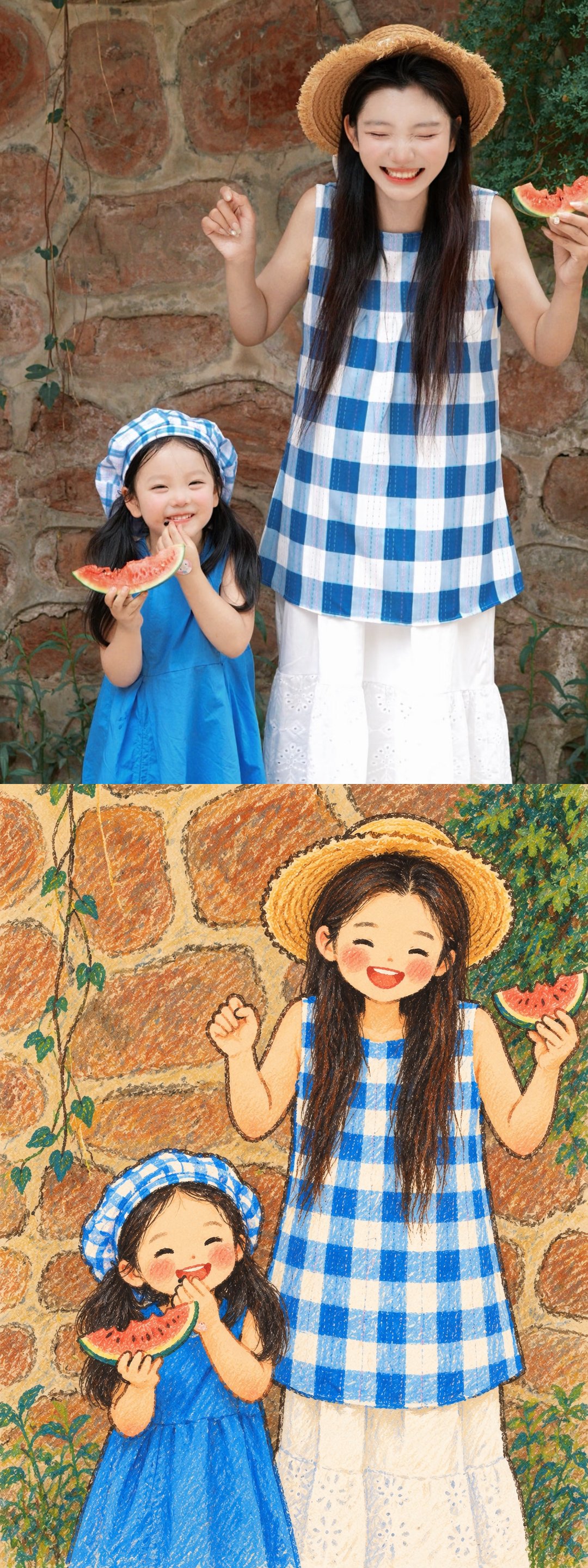
Redraw the uploaded image as a warm, charming everyday-life picture-book illustration, using coarse oil-pastel and wax-crayon marks with colored-pencil accents. The uploaded image is the sole source of people, objects, actions, and scenery. Transform the shapes, contours, color masses, and mark-making into a coherent illustration; simply adding paper texture or grain to the photograph is insufficient.
OVERALL STYLE
Make the image look drawn directly on warm ivory paper. Combine soft, substantial color shapes, rough dark outlines, and clearly visible crayon strokes. Aim for an affectionate, unpolished handmade quality, with slightly imperfect drawing and the feeling of an ordinary moment recorded in a family picture book.
LINEWORK AND MATERIAL
Outline people and major objects with grainy charcoal-black or dark-brown strokes. Let contours wobble slightly, vary naturally in thickness, and show broken edges, rough deposits, and small gaps of exposed paper. Keep interior lines lighter and fewer.
Build color through short strokes, diagonal scribbles, back-and-forth rubbing, and uneven overlapping layers. Paper grain should remain visible through both outlines and filled areas. Even dark masses should contain tiny lighter gaps. Texture must follow the drawing strokes rather than appear as uniform digital noise. Allow occasional slight overshoot and incompletely filled edges while keeping the main shapes clear.
CHARACTER DESIGN
Clearly cartoonize the people: moderately enlarged heads, rounded faces, full cheeks, simplified chins, and soft, compact body and limb shapes. Preserve the rounded proportions of young children while keeping adults visibly distinct in age and body structure.
Retain each person's visible hairstyle silhouette, hair color, approximate face shape, eyewear, distinctive accessories, and general build. Do not give everyone the same face.
Draw eyes as small solid-black dots or short ovals. Use simple short strokes for eyebrows, a tiny dot or minimal mark for the nose, and a small curve or uncomplicated open shape for the mouth, preserving the source expression. Add soft peach-pink blush to the cheeks where appropriate. Avoid realistic eyeballs, irises, eyelashes, large sparkling eyes, and detailed facial anatomy.
Consolidate hair into substantial overall shapes with rough color coverage and a few directional strokes, without rendering individual strands. Simplify hands and feet into rounded forms while maintaining clear grasping, contact, and support relationships.
COLOR AND LIGHT
Establish a warm base of cream, ivory, peach skin tones, and soft browns while retaining the source image's main object colors. Use natural crayon yellows, greens, blues, and reds rather than fluorescent colors or a uniform faded filter.
Express most volume through color shapes, contours, and overlap. Suggest shadows sparingly with darker strokes from the same color family or muted gray-brown patches. Replace photographic shading, glossy reflections, and complex gradients with simple drawn color relationships. Preserve the visual weight of dark hair, dark clothing, and strong outlines.
CLOTHING, OBJECTS, AND ENVIRONMENT
Preserve clothing categories, main colors, recognizable patterns, accessories, and important props from the source. Translate folds, patterns, and object structures into a limited number of drawn lines and color patches rather than intricate material detail.
Redraw the entire background in the same handmade visual language. Preserve the positions, major shapes, and spatial relationships of furniture, buildings, trees, roads, and other scene elements. Simplify detail while retaining enough everyday information for the original setting to remain recognizable.
Keep facial features extremely simple, clothing and props selectively descriptive, and environmental marks richer but still broadly drawn. The background must not retain photographic texture or automatically become blank white or a solid color.
COMPOSITION AND CONTENT
Preserve the source aspect ratio, viewpoint, shot size, main subject placement, number of people, actions, gaze directions, and overlap relationships. Apply the same illustration style to every person in a group photograph.
Allow local proportion changes for cartoon design while preserving the meaning of the scene. Do not expand the canvas or invent body parts and objects outside the original frame.
The style controls how the source is drawn. Do not introduce babies, food, phones, festive decorations, or any other content absent from the uploaded image. Simplify existing text and signage according to their visual importance. Add no new text, watermark, or signature.
AVOID
Photo tracing; a photograph with a texture overlay; realistic portraiture; smooth vector art; mechanically uniform outlines; transparent watercolor washes; detailed graphite drawing; large anime eyes; sparkling eyes; plastic surfaces; 3D rendering; complex photographic lighting; finely rendered hair or skin; random grime; excessive blur; and inconsistent styles between characters and backgrounds.
Output exactly one finished illustration, with no collage, comparison panel, or explanatory text.